


Growing up in Sicily in the early eighties felt like living on several inner layers at once. On one layer there was my family: fairly wealthy, but always on the brink of some kind of financial or psychological disaster. The kind that doesn’t announce itself—it just hangs in the air, and then someone is shouting and the wrong dosage of salt in a salad plate becomes the firing shot of the next argument.
On another one there were my friends, with strong political convictions and an honest appetite for change and peace—while the Cold War kept dropping its latest absurd breadcrumbs across the television like bad recipes for an unpurposeful official dinner. Below all, a rumbling bass note no one could fully escape, was the mafia presence. The Second Mafia War was still fresh in the streets and in people’s eyes. Blood ran on the boiling asphalt, and judges were running for their lives, and the lives of their families.
Meanwhile, my schooling was, at best, flexible. Most likely because a new mobility element had entered my life: a small engine on two fantastic wheels. And that meant freedom—the kind that makes you forget to look at the future further than your nose, and lets you be stuck in the present. Adventures that alone would be worth another telling, but I will leave those for another day, and another tack.
Then, while I was still smelling the air running in my face and keeping myself striving as best I could into those politics, the bombshell came. Sicily was chosen by the American government to become the host of a new nuclear missile base right in its middle, among lemon trees and grapevines—both of which my palate and drunkenness still does remember quite well.
I was seventeen at the time, and while I could not identify myself as the strongest politically prepared individual, I was appalled by such a social face-slap possibility. My political education was rooted in liberalism and communism of its finest sources. Those open ideologies were evident in the presence of a huge mural situated right behind my father’s drawing desk, portraying the face of Che Guevara and saying, “ahora la cosa marcia.” In reality, things were not going as well as he expected, but I was growing within his and my mother’s sphere of political and social influence—and I still try to make the best of it, even after all those years.
From the beginning, while the government forces were working to accommodate the Americans, the Italian and European movement decided to organise peaceful protests all over Italy, and to create a permanent peace camp located in Comiso, in order to coordinate the protest and build a structure capable of protesting against the military base and its absurdity.
Our intent was simple and concrete: block access to the base. Stop the workers from entering the workplace and contribute to the greater cause of leaving such a beautiful part of our land intact. Hold the gates with our bodies and, at the same time, speak to the workers directly—pull on their conscience, ask them to stay out with us, and to trade the immediate, limited reward of a day’s pay for something larger. The stubborn goal of peace. We didn’t see them as enemies. We saw them as people who had been asked to build the wrong thing in the wrong place. Humans, just like us.
The big question was posed onto my kitchen table at dinner, which provoked some marginal choking in the mouths of both of my parents, who—after a small debate—agreed to let me go and join the camp as long as it didn’t interfere with school, most specifically during the summer. My guess is they also realised that my absence would give them the chance to keep on fighting each other and demolishing some more china without risking further hurt to my feelings—and at times my being as well.
I joined forces with a few friends and departed Messina on a dusty regional train, which, melting in the heat, slowly took us to our desired destination: chasing peace together. At the time the camp was made of a headquarters inside a building in Comiso, and an additional large campground in which there were tents and people from all over Europe, including, quite interestingly, a high number of Dutch, who were without doubt among the strongest paladins against nuclear establishment of any kind, and did teach us more than a thing or two about nonviolent active protesting.
Everything went smoothly for a while: daily sit-ins on the airfield surroundings, peaceful protests in town, and debates on how to conduct our protest moving forward. Then, at the beginning of August, things began to escalate. Even the air seemed firmer and without an escape route; its substitute was the dust, so thin it would appear inside our pockets.
One week in particular, things heated up. Was it the constant heat? The growing demands from government forces far away? I could not say. But on the night of the 7th of August a strange awareness began to fall on our faces—its quietness more intense, like expectations gathering for what was ahead. Not sure any of that was palpable, but we could feel a switch in the way policing authority were taking their daily steps.
On the morning of August the 8th, the camp woke like a single organism—not with speeches or rush, but with a low rumble without a distinctive origin. People folded blankets, tied shoes, passed information in low voices, while sharing coffee that tasted like burnt objectives. The goal for the day was the same: stand in front of the gates and slow the work inside the airfield, meant to prepare the place to welcome those deadly beasts. Not much change from the previous days—more dust, more heat—but nothing else noticeable.
By the time the sun came up, we were in front of the gate and the initial part of the walls—a thousand of us—forming a semicircle that almost touched the defending lines of Carabinieri, all in full display. Their shoulders filled with weapons and dust, sweating the upcoming day in silence, with a new uncertain look on their faces.
Then we realised a new element had taken its place in the improvised platoon: the police in full uniforms. A lot more than on any previous day. More helmets, more shields, more bodies in formation. Not shouting, not dramatic—just present in a way that murmured.
“we’re done pretending this is a gentle morning conversation.”
The workers arrived around seven. In an ordinary way, showing up for a shift, and with a few slowing down for what we hoped was the opportunity to exchange a few words. Some looked away. Some stopped. We spoke to them the way you speak to someone you don’t want to disturb—directly, simply, politely—offering them the option to notice the impasse.
“Look at where you are. Look at what you are about to do. Don’t cross.”
A few smiled and turned back. A few stayed and talked. Some hovered at the edge of the blockade, caught between a job and a conscience. But nobody forced their way through. And for a short time it felt like we might hold the day just by standing there, like close friends discussing the weather ahead.
Then the late morning tightened. You could sense the change before you could touch it. The police wanted to rotate their standing line at the gates—and we knew what that meant. The movement would create cracks the workers could walk through, so we pressed closer together and, shoulder to shoulder, we began to chant. We sang. Not to be cheerful, but because those sounds keep everyone from dissolving into fear.
Then, from the corners of our eyes, more reinforcements came. Vehicles from the sides. Doors opening. Quick movements, lines thickening like a theatrical play that had begun to run. And then came the scream of the siren. That sound didn’t just announce a scene change—it was a message to both them and us. It announced a decision:
“this is no longer about moving people; this is about breaking them hard. Not only your soul, but your body as well.”
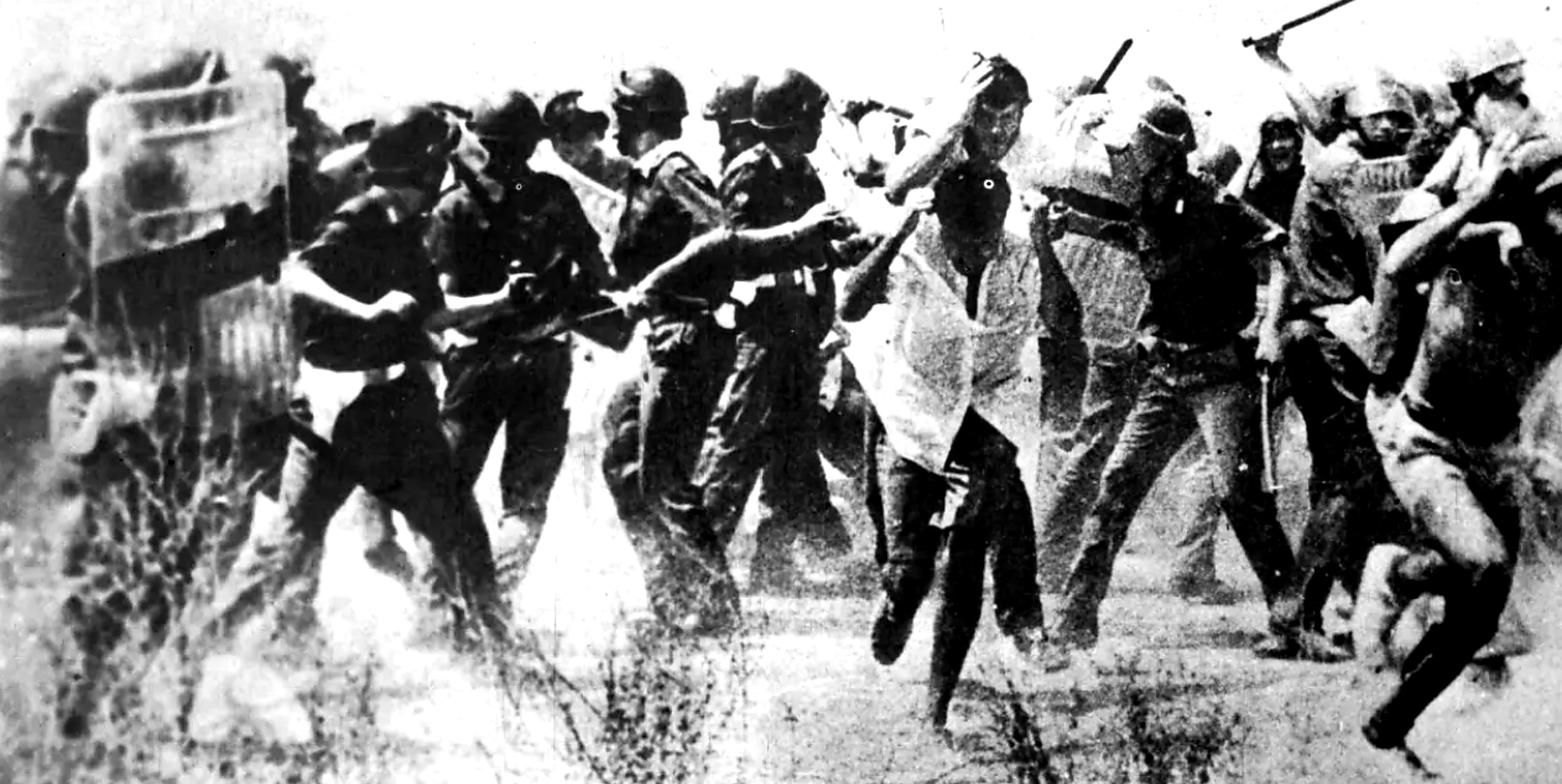
Their charge hit fast, and in the confusion bodies jolted—someone falling, someone yelling a name, hands grabbing wrists. This was not a joke; it was an unwarranted attack. Among lemon trees, a battle against unarmed people had begun.
Our semicircle collapsed into fragments. People ran everywhere: across the vineyards, back toward the camp, sideways into whatever space looked like escape. Then came the tear gas. At first it’s a sting—then your eyes are on fire and your throat becomes a narrow tube and your brain starts bargaining with your lungs. Breathing becomes work. Thinking becomes secondary.
In the midst of the screams, a roar from the sky. I looked up and saw the helicopter, with huge cameras and gas cannons as well. A helicopter, I told myself, for a few peaceful folks in dust clothes.
I ran, and in the confusion, while escaping from the hard hit of a policeman’s foot, I saw someone who, in the middle of that chaos, was taking pictures, a handkerchief on her face, she stood there defiantly, with the stubbornness of someone who truly believes images matter.
Then I suddenly realised two cops were running in her direction for the grab. So I pulled her arm and dragged her away in a panic, adding to my own fear her own, and probably creating more confusion in her than any sense of security. Like pulling someone out of a doorway before it slams. We stumbled, half-running, half-tripping, coughing, eyes watering, her camera knocking against her chest like a visible police magnet.
In the panic we cut sideways through a few small bushes, away from the main line, and then—a mercy in the middle of ugliness—a nearby car stopped. A door opened. Hands reached out, grabbing our clothes and pulling us onto the back seat with the kindest violence anyone would like to experience. For a few seconds, the world inside that car was its own small universe: coughing, spit, tears you can’t control, screams and open fears. Both in shock, but in a sudden intimacy created by mixing fear and hope, shock and horror.
It was then that I felt a surge of love. Not in a romantic way, but in the way people love others in the midst of sudden events and want to care for them until they fall silently in our arms. She made me feel human again, while I was in total uncertainty inside a very inhuman day.
What happened afterward has been written many times, and I’m not arrogant enough to think I can improve on it. Still—if I stop here, it feels like I’m cheating both history and you. So I’ll sketch what came next as plainly as I can, with the humility of someone who knows he’s only holding one little corner of truth.
Despite everything, the government announced in March 1983 that the first 16 missiles were already operational in Comiso, and that all 112 would be operational by June 30, 1983—as if that kind of thing could be filled on a calendar.
Comiso didn’t let go quietly. Initiatives continued, pushed hard by the women of La Ragnatela, who even entered the base at night on April 21. Later the fight became more practical—municipal resolutions, direct actions, even attempts to interfere with the movements of the TELs (Transporter, Erector, Launcher) as exercises began.
Luckily by 1984 the energy thinned out, and then the world shifted. In March 1985 Chernenko died, Gorbachev arrived, disarmament talks reopened, and on December 8, 1987, Reagan and Gorbachev signed the agreement that finally closed the Euromissile chapter, which almost immediately delisted the base of Comiso from the already complex military map in EU.
Today, that airfield is no longer a military project. It’s a civilian airport—trying, in its own way, to become another gate to Sicily, alongside the larger airports of Catania and Palermo. And every time I think of that, I return to a simple image: the same place that was meant to welcome weapons now is trying to welcome returning migrants, tourists, luggage, embraces, and departures.
I wish I could say that since then things changed in the public process of peacefully expressing your ideals. Unfortunately, much more drastic and dramatic events have taken place in Italy since then, and new laws are now being made to prevent those expressions, limiting freedom, and openly antagonising who is different from you—in a clear Orbán-style fashion, in which even the press and the judiciary system are being held accountable and run the risk of being completely controlled by the political system.
Thanks! I really appreciate your kind portrait. Those are difficult times in this world, and only those sudden and unexpected bonds can help us saving it.