


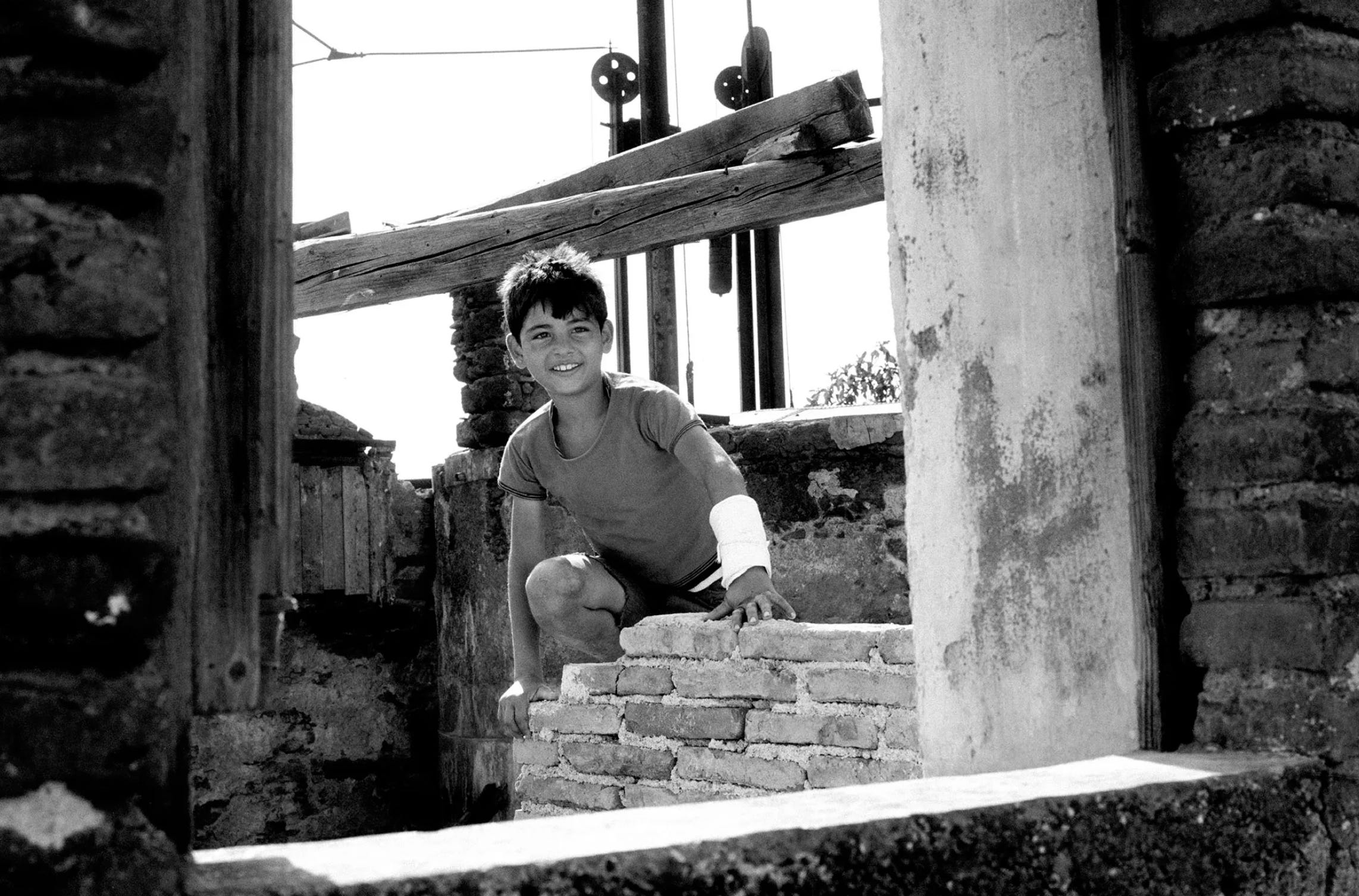
Like many landowners in 1970s central Sicily, my grandfather didn’t have a driver’s license — not even after having been a tank commander for the Italian Africa Corps in the war. He preferred, instead, to be driven. He relied on a dedicated driver, someone always at the ready to take him wherever he wished.
Seeing him like that — seated in the front, never driving, but always commanding — gave me a sense of grandeur and power. Even if the car itself, a diesel Peugeot 404 Break L, was far from glamorous. You could hear it coming from half a valley away.
Whenever he invited me to join, I ran with trepidation toward the waiting car. The driver, Turi Tataranchio, would be holding the rear passenger door open for me, never closing it until I was properly seated. That soft click, followed by the firm, practiced motion of Turi’s hand closing the door — it always marked the start of something exciting, no matter the distance.
Turi had the look of a Sicilian crow. His skin was dark and leathery, his hair a wild battalion of curls in open rebellion, and his moustache sat thick above small, pale lips. He rarely spoke. When he did, the words shot out in a rapid-fire code — so unintelligible I thought, for years, he might have invented his own dialect. It sounded like a mix between the growl of a Nebrodi wolf and the whispering hiss of the scirocco under a closed door.
His clothes, too, seemed to mirror his contradictions. There was always a trace of formality — a white shirt, a crooked tie — suggesting pride in his role with our quasi-noble household. But they were always slightly stained, slightly rushed, as if he’d dressed while already halfway out the door. He was like a small, perpetual fire — never quite still, never entirely contained.
As a child, forever finding new ways to scrape my knees, I was fascinated by Turi. He could drive. He could go places. I, by contrast, was confined to our hazelnut farm, constantly watched by the worried eyes of my parents — well aware they had a miniature monster on their hands.
One late summer day, my grandfather, then beginning to show signs of illness, called me to his bedside. With a gentle voice and trembling lips, he asked if I’d like to accompany Turi into town — to pick up pastries for Sunday lunch. I stammered out some kind of “yes,” heart racing, lips trembling.
He reached into his pocket and pressed a 500-lire note into my palm — the worn paper warm from his fingers. It was for my own pastry, he said. But I mustn’t tell a soul — not my cousins, not anyone else in our large, hungry family.
I pressed my finger to his shoulder and ran, rich and sweaty and poised for freedom.
Turi was already on the far end of the driveway, heading toward the car. I sprinted after him, panting.
“Are we going now?” I asked.
He looked at me like I’d stepped out of the bushes as a ghost. Then, wordlessly, he nodded, a cigarette clenched beneath his moustache, and continued walking.
The Peugeot, parked in the shade behind the tool barn, radiated heat like a brick oven. Turi approached it as if it might bite — cautious and deliberate. He opened all four doors, peeked inside without breathing, and then rolled down every window.
Still too hot.
But my eager expression said there was no time to lose. A cassatina and two dozen cannoli awaited us on the other side of the valley — and I wasn’t about to make them wait.
Then, something extraordinary happened. Turi gestured for me to sit in the front seat — not in the back, as usual. Today, I was the stand-in for the Baron.
I climbed in, honored and elated, barely noticing the burning leather beneath me. The seat scorched my legs, but I didn’t feel a thing. My adventure had begun — a miraculous breeze had rescued a stranded sailor.
The car roared to life, and as it took the first curve downhill, it seemed to move in perfect rhythm with the breeze rushing through the trees. It wasn’t just us breathing now — it was as though the whole Earth was inhaling, exhaling, and wrapping us in its finest smells and sounds.
With each turn, the engine’s growl echoed into the heat, and the trees waved us goodbye. But I was transfixed — watching Turi’s feet and hands in motion, dancing between clutch and gear stick. His driving was rough and gentle at once: short, abrupt shifts on the descent, soft and slow ones on the straights.
The car must feel like a horse to him, I thought. And he — the quiet rider, commanding it with strength and grace.
Before I could lift my eyes, we were already at the edge of town.
Ucria: a small, straight-spined place of grand family palaces and humble peasant homes, pieced together like an urban mosaic across centuries of nobility and toil. We climbed the street and soon arrived at the pasticceria, itself a kind of monument in the heart of town.
Turi switched off the engine and came around to open my door — only to find that I’d already jumped out into the baking square. I nearly lost my balance pushing open the glass-paneled door, but when I stepped inside, I felt salvation.
Cool, dark, and rich with scent. The air hit me like a benediction — marble floors, dim light, and aromas of cinnamon, orange peel, linen, and dark chocolate rising like incense.
“Come sta il signorino?” asked Prospera, the shopkeeper, her voice warm and round.
“Molto bene,” I answered, licking my lips.
I placed the order and added a cassatina for immediate consumption. She nodded and ushered us to a side table. Turi simply nodded in return.
A moment later, Prospera appeared with an espresso for Turi, a glass of water, and my perfect pastry.
I ate in silence — as if in prayer — surrounded by the humming of the fridges and machines. This was the church of my faith, where the gods were sweet and generous. If food were a religion, I would have gladly become its devoted priest.
Turi sipped his coffee quickly, vacuuming the last drops as though they were essential to life. He gestured softly — it was time to go. I swallowed my last bite, already wishing I had more, when Prospera reappeared with the box of cannoli.
No need to pay. Like many families, we had an account, which my grandfather — the Baron — would settle in his own time.
Just a smile, a nod, and we were off, back into the sun’s cruel glare.
Turi held the box as he opened the car door. The heat from the Peugeot poured out like breath from a glass furnace. I climbed in, instantly searing my legs, and cursed my decision to wear shorts.
Why was I such a hopeless rascal? Was it instinct or sport? I didn’t know. I didn’t care.
Life was good. Perhaps too good.
As we began the long climb up the hill, Turi glanced sideways and suddenly froze. His eyes went wide, fish-like, as he took in the mess I’d made of my shirt.
He slowed the car to a stop and muttered, almost incomprehensibly, “Permette, signorino?”
Then, with the care of a tailor, he brushed every last breadcrumb from my shirt, making sure I looked presentable once again. Only then did he smile and start driving.
I smiled back, thinking: He saved me. Maybe that’s why Grandfather keeps him always at his side. Maybe Turi is his savior too.