


It is not hard to imagine my feelings as I took one last look at the buildings surrounding my tall-ceilinged roman apartment in the San Lorenzo neighborhood before deciding to push my entire life across the pond to America. I was leaving what I loved the most for a place I would come to love even more — at least for a few years, before the word America itself would begin to change shape. Unthinkable today.
It was a gorgeous day in July 1998. My pregnant girlfriend was beaming with joy, quietly watching my uncertainty about what lay ahead. She would go first. I would stay behind a little longer, finishing the packing, selling the last things that could not come with us — among them my motorbike, one of the most painful losses, because I knew I would not find anything like it again for a long time. In those days, leaving still felt like adventure, not escape — a joyful jump into another kind of waterfall.
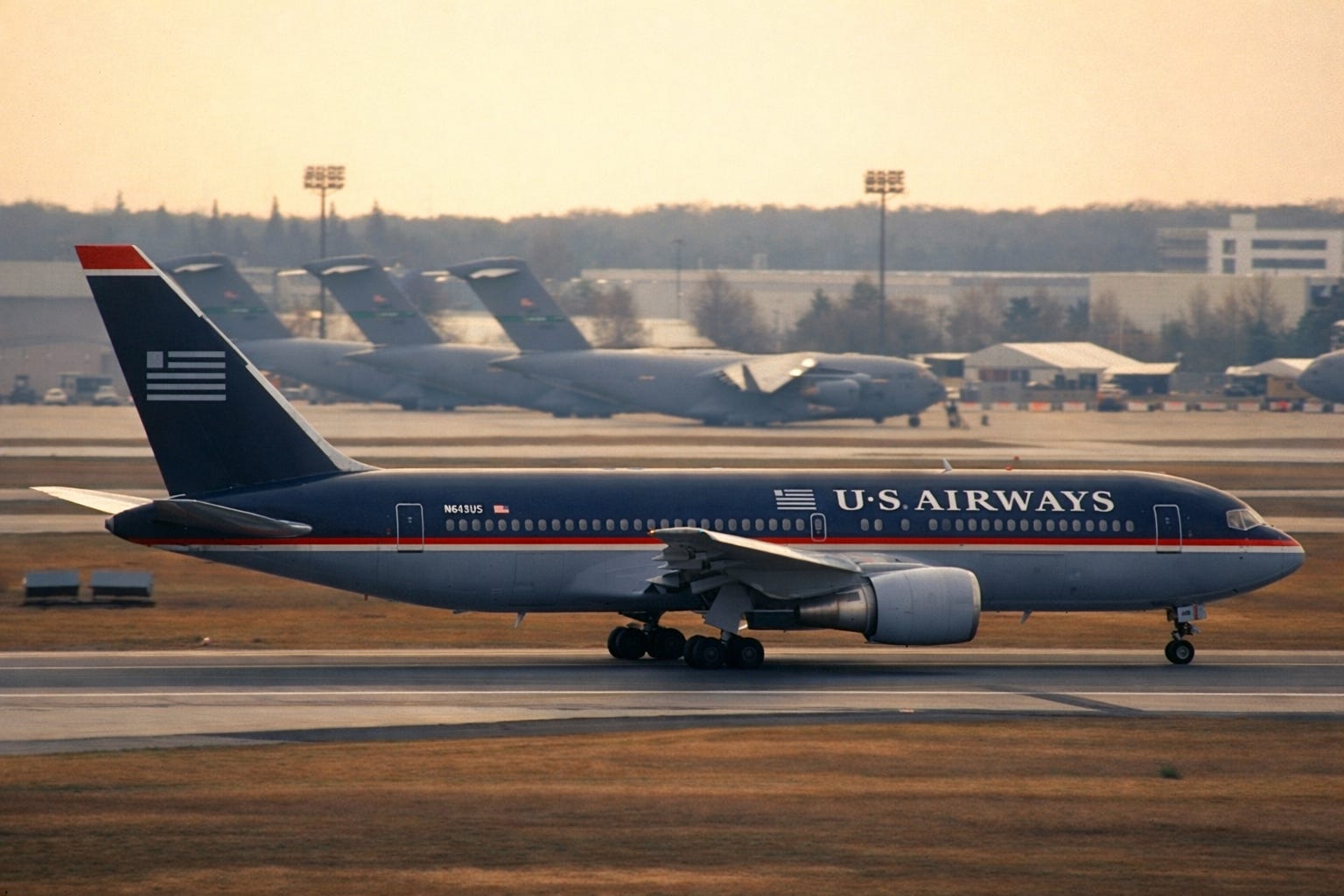
My flight was booked on US Air — itself now a strange fossil of aviation memory — from Rome Fiumicino to Philadelphia on a luxurious 767, then onward to Hartford on an already old-looking but sturdy 757, possibly still the best airplane Boeing ever built. That promised landing in Hartford, Connecticut, where my girlfriend would be waiting in her Subaru, pregnant and glowing, surrounded by the green valleys of the Berkshire region, would become my first American home — a place that felt as wide open as the future itself once did.
If you are expecting the mountain of paperwork that would accompany such a move today, you would be wrong. There was no visa, no ESTA, no interviews. Only a small cardboard form handed to you on the plane, where you declared — on your own honor — that you were not a criminal, not a drug dealer, and had no intention of committing wrongdoing. Not in an office. Not at an embassy. Just seated over international waters, given to you by a smiling stewardess, with the simple instruction to show it with your passport on arrival. Impossible now, even in the most remote country on earth. But that was America: brave, curious, still willing to believe that strangers might arrive carrying more than fear.
The cockpit door was left open. You could see the pilots working in the dark. Even the air inside the plane felt open — light, trusting, welcoming. My English was almost nonexistent. I smiled a lot. I said “thank you” every time someone spoke to me or handed me something, as if politeness itself were a kind of visa. I did not yet know how rare that openness would become.
Philadelphia was noisy, hot, and sticky. My eyes were wide as I watched what looked like a perfectly oiled machine — people moving, working, talking, flowing in every direction. I remember running toward a sign that promised Italian cuisine, and being surprised that it wasn’t half as bad as it would seem to me today. Pizza e Pasta, it was called. I still wonder if it exists now, and what kind of people might be eating there.
I sat in a warm corner of sunlight, watching planes take off and land — still one of my great, enduring passions — trying to digest the magnitude of what I was doing. Was this the first time I had erased one life in order to step into another? Certainly not. I had always been a kind of gypsy, and the excitement of what might come next — something entirely new — easily outweighed the fear and the language barrier. Back then, the future still felt like an open door, not a wall, never a barrier.
What would America be for me?
What would it give me — as a career, as a life?
I did not know then how right I was to hope. This country — now so deeply unrecognizable — gave me more than any place ever had before, certainly more than I could have imagined.
The flight to Hartford was messy, with heavy rain and turbulence. I wasn’t too worried — after years of flying between Rome and Sicily in winter on lighter MD-80s, I was used to it. But an old lady across the aisle looked terrified. I smiled at her, as if to say everything would be all right. She smiled back, grateful. I sometimes wonder where that small, unguarded kindness has gone.
Outside the airport, in the eager arms of a soon-to-be mother, I smelled the night for the very first time — grass, mud, flowers — filling my lungs like water in the desert. The air was so clean it felt unreal. Was this the nature we had forgotten in Europe? Or was it simply a country still young enough to let you breathe?
The drive through the dark was pure magic. Green hills rolled endlessly, no streetlights, no houses, only the shapes of forests untouched by human hands. Turn after turn, it felt like passing between sleeping giants, watching us quietly as the car slipped through their territory — a world that had not yet learned how to be afraid of itself.
Arriving in Great Barrington, Massachusetts, just a couple of hours from New York City, in the dark was another surprise. Small glowing windows of shops and a few restaurants spoke of calm, of a warm and gentle summer night. Fireflies drifted in the air, as if curious to touch your face. I don’t know if they still shine like that now, but I hope so, and often long for it.
This was my first night in America — an open field for both my mind and my future. Just the first taste of a much larger country I had not yet begun to walk through, a place that would open and close its doors in ways I could not yet understand.
The next morning, a lawn mower shattered my first American dream, rolling the smell of fresh grass straight into my jet-lagged face. Loud, abrupt, alive — the first sound I truly heard upon waking in America. A country was waking up, and so was I.
I did not yet know how many more stories were already waiting for me — interviews, connections, misunderstandings, fatherhood, cold winters, and a long list of quiet human victories — all of them pieces of a place that would one day feel as distant as this first, innocent morning.